Agent Wallets Are Here. Here’s the Data Layer They Still Need.
Agent wallets let AI execute on-chain with policy limits, but they don't tell agents what...
Mon, Jun 15
By: Datai Network
AI agents are no longer stuck on the sidelines of Web3.
They can hold wallets. They can sign transactions. They can swap tokens, provide liquidity, and run multi-step DeFi workflows, often with policy limits baked in so they don’t have full control of a user’s keys.
MetaMask’s Agent Wallet, launched in early June 2026, is the latest signal that this shift is real. Agents built on frameworks like OpenClaw, Claude Code, and Cursor can now connect to a self-custodial wallet and operate across EVM chains with spend limits, whitelisted protocols, and transaction simulation before anything hits the chain.
That’s a major unlock for builders.
But here’s the part that doesn’t make the launch headlines: an agent that can transact still can’t reason about what it’s transacting with, not unless you give it a data layer built for machines, not humans.
The bottleneck moved: from signing to understanding
For years, the hard problem in on-chain AI was access. How do you let an agent sign a transaction without handing over a private key?
Account abstraction (ERC-4337), EIP-7702, and agent-specific wallet products have largely solved that layer. Agents can operate within guardrails: daily spend caps, approved contract lists, MEV protection, threat scanning.
The constraint has shifted.
Raw blockchain data is structured for nodes, not for reasoning. A transaction log tells you that something happened at an address. It doesn’t tell an agent:
- What kind of contract it interacted with (DEX, lending pool, bridge, NFT marketplace)
- What protocol category the interaction belongs to
- What DeFi position changed and what the updated exposure looks like
- What the PnL impact is in USD
- Whether the same action on a different chain would parse identically
Without that context, agents aren’t making informed decisions. They’re pattern-matching on hex strings, at machine speed, with real capital.
That’s not an intelligence problem. It’s a data problem.
What changed in 2026: and why data requirements got harder
Three trends are converging at once, and each one raises the bar for on-chain data infrastructure.
1. Agent wallets went production
Agent wallets are no longer a hackathon demo. Products like MetaMask Agent Wallet support swaps, LP, perps, and prediction markets across major EVM chains, with security layers like transaction simulation and threat scanning before execution.
When agents can act autonomously, the cost of bad context isn’t a wrong answer in a chat window. It’s a wrong transaction.
2. Agents are starting to pay for services
The x402 protocol, a standard for AI agents to pay for APIs and compute via stablecoin micropayments over HTTP, has moved from announcement to production use. Agents aren’t just reading chain state. They’re purchasing data, API access, and compute programmatically.
That only works if the data they buy is structured, consistent, and immediately actionable. Dashboards built for human analysts don’t fit the model. Agents need API responses they can plug into logic without a human writing SQL first.
3. Multi-chain is the default, not a roadmap item
Agents operating across Ethereum, BNB Chain, Base, Arbitrum, and beyond need a unified schema, not a different parsing pipeline per chain. If your data layer returns different field names, different levels of enrichment, or different labeling logic depending on the network, your agent’s behavior becomes unpredictable.
The agent economy doesn’t need more chains supported. It needs the same semantics everywhere.
What agents actually need from on-chain data
If you’re building an agent that touches wallets, DeFi, or on-chain workflows, your data layer needs to deliver more than balances and transaction hashes.
| Need | Why It Matters |
|---|---|
| Labeled smart contracts | So the agent knows what it interacted with — not just that it interacted. |
| Protocol categorization | So routing logic can treat lending, swapping, and bridging differently. |
| DeFi position tracking | So the agent understands exposure, not just token balances. |
| PnL and USD-denominated metrics | So policy rules (“don’t exceed $X daily loss”) can be enforced. |
| Unified multi-chain schema | So the same agent logic works on every chain you support. |
| Real-time + historical context | So agents can react now and learn from past behavior. |
This is what we mean by AI-ready data: blockchain intelligence that’s enriched, structured, and delivered via APIs, ready for models and agents to consume without a human in the loop.
It’s the difference between handing an agent a receipt and handing it a labeled financial report.
Why RPCs and dashboards aren’t enough
“Just use an RPC” is common advice. It’s also incomplete, especially for agents.
RPC providers give you access to chain state. They don’t give you meaning. You get logs, receipts, and contract bytecode. You don’t get automatic classification of 4,000+ protocols, consistent field names across chains, or ML-labeled contract types updated in real time.
Dashboards and query tools solve a different problem. They’re built for human analysts who can interpret charts, write queries, and apply judgment. Agents need machine-consumable outputs, JSON schemas they can act on in milliseconds.
And building your own labeling pipeline in-house? That’s months of engineering before you ship a single agent feature, plus ongoing maintenance every time a new protocol launches.
The teams shipping fastest aren’t building data infrastructure. They’re plugging into an enrichment layer and focusing on agent logic.
What an enrichment layer looks like
At Datai, we’ve spent years on the layer between raw chain data and the applications (and agents) that need to use it.
Our architecture follows three layers:
- Data sourcing: A decentralized indexer network where node operators and developers contribute protocol integrations, scaling coverage across chains and verticals.
- Data refining: Proprietary ML models that take raw contract bytecode and transaction patterns and output labels and categories: DEX swap, lending position, bridge transfer, NFT mint, and more. We’ve labeled 2.5M+ smart contracts this way, without a manual taxonomy team maintaining a spreadsheet.
- Application: 50+ API endpoints and an MCP layer so agents can query wallet intelligence via structured APIs or natural language.
The outcome isn’t more data. It’s data that answers the questions agents actually ask: what is this contract, what changed in this wallet’s DeFi exposure, what’s the PnL on this position, and does this behavior parse the same way on Base and BNB Chain.
That’s the layer agent wallets don’t include, and shouldn’t have to. Wallets handle signing and policy. The data layer handles comprehension.
A builder checklist: 5 questions before you wire your agent to raw chain data
- Can my agent identify what a contract is without custom heuristics per protocol?
- Will my schema stay consistent across every chain my agent supports?
- Can my agent understand DeFi positions, not just token balances?
- Can policy rules reference USD-denominated PnL and exposure?
- Am I building a data pipeline or an agent?
If more than 30% of your roadmap is parsing, labeling, and maintaining protocol coverage, you’re in the data business, not the agent business.
When raw RPC is enough
If your agent only needs native token balances on a single chain and never interprets contract interactions, RPC may be sufficient.
But the moment your agent starts interpreting on-chain activity, recommending trades, assessing risk, rebalancing portfolios, reporting to users, or enforcing compliance rules, raw data stops being a shortcut and starts being a liability.
The agent wallet era assumes your agent understands what it’s doing on-chain. That assumption only holds if the data layer does the comprehension work upstream.
Ship agents, not parsers
Agent wallets handle execution. Payment protocols like x402 handle machine-to-machine commerce. What’s still missing in most stacks is the enrichment layer that turns chain activity into structured intelligence.
That’s what we’re building at Datai: the modular data layer powering on-chain AI. 2.5M+ smart contracts labeled. 4,000+ protocols covered. 50+ API endpoints. MCP for natural-language wallet queries.
Ship faster. Parse less.
→ Explore the docs: https://datai.network/docs/introduction/overview
→ Try Datai MCP on GitHub: https://github.com/Datai-Network/datai-mcp-server
YOU MAY LIKE
Datai × ChainComply: Adding On-Chain Financial Context to Crypto Compliance Investigations
How Datai adds DeFi portfolio and transaction context to ChainComply’s crypto compliance investigations.
Wed, Sep 16
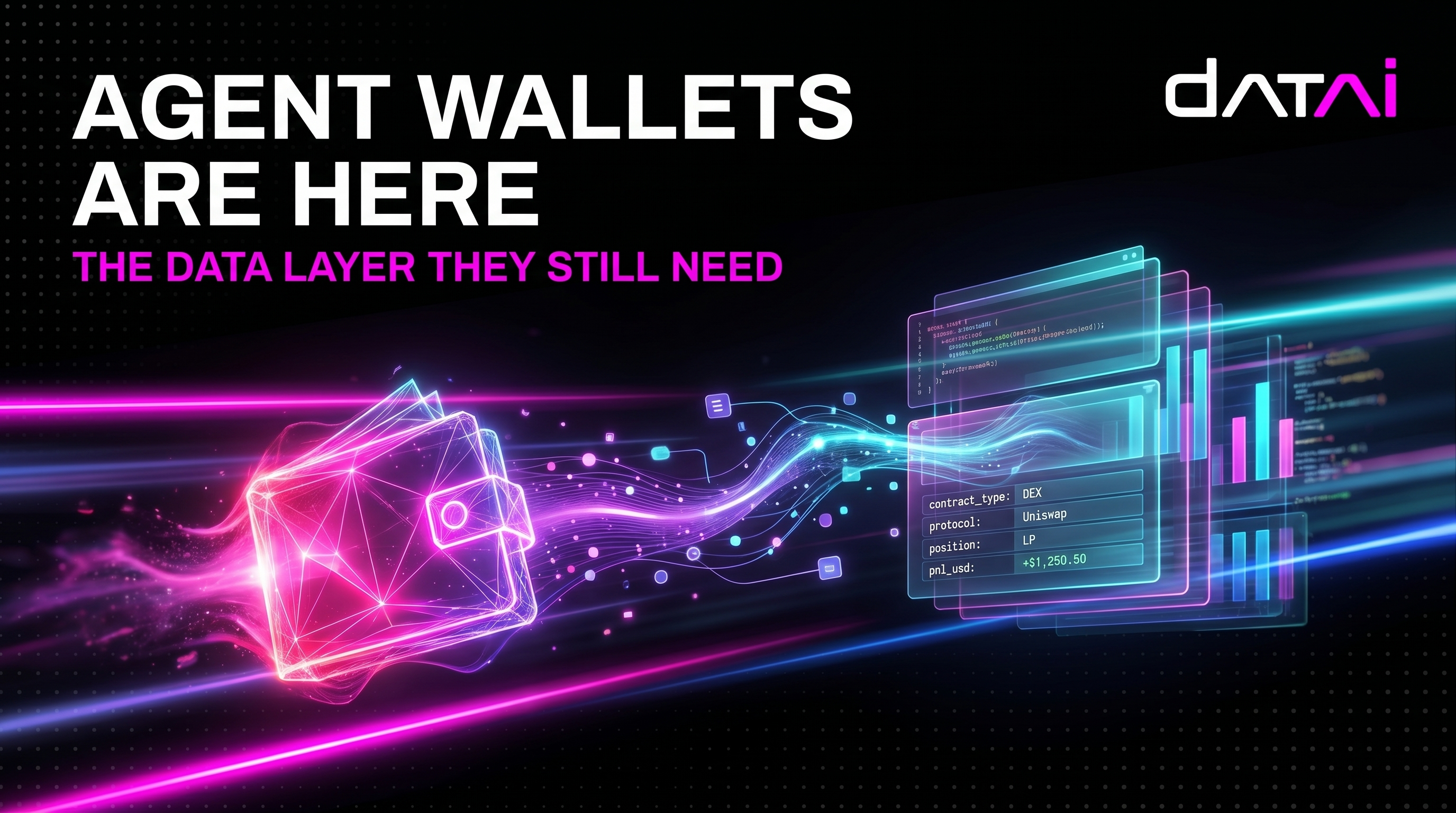
Agent Wallets Are Here. Here’s the Data Layer They Still Need.
Agent wallets let AI execute on-chain with policy limits, but they don't tell agents what they're transacting with.
Mon, Jun 15
Join the datai community
Our ecosystem is thriving with contributors from all over the blockchain world. Whether you’re a developer, node operator, or token holder, there’s a place for you

